
CARDOZO FINE ART
Our reputation is built on our knowledge, integrity & values
VINTAGE ORIGINALS
All vintage original's are From the private collection of
Christopher Cardozo

This is Assiniboin Mother and Child by Edward S. Curtis, one of the sepia photogravures from his sprawling project The North American Indian, which he worked on for the better part of thirty years. A young Assiniboine woman sits on the ground in a stand of aspens, holding her baby, who's snugged into a beaded cradleboard and fast asleep. She's dressed in fringed hide with geometric beadwork and a patterned cloth wrapped around her head, and she's looking down at the child with this soft, unhurried attention. The whole thing has a hushed quality to it the warm light filtering through the trees, the stillness, the sense that you've quietly stepped into a private moment between the two of them.

Old Trail at Acoma, 1904
Two riders climb the ancient path to Acoma, threading between towering walls of weathered sandstone toward the pueblo perched high on the mesa above. Known as "Sky City," Acoma is among the oldest continuously inhabited communities in North America, and for centuries this narrow trail carved into the rock was the only way up. Photographed for Curtis's monumental The North American Indian, the image sets the small figures of the riders against the vast New Mexico landscape, its signature sepia tones lending the scene a quiet, timeless atmosphere.
Plate 567, Portfolio XVI of The North American Indian. Printed on Japanese Gampi Tissue, 18 × 22 inches. Condition: excellent.

East Mesa Girls, 1921
Hopi individuals from the East Mesa of Arizona (originally photographed around 1906, published in 1921)
Plate 427 Portfolio XII
Japanese Gampi tissue paper
18x22"
Plate 427, Portfolio XII

"Two women wearing the primitive bark blanket and nose-ornament, and with clam-baskets on their backs,
rest on the beaches while waiting for the tide to fall and uncover the clam-beds."
From Edward Curtis and The North American Indian
$10,500.00 Special Price Through April - $8,000.00
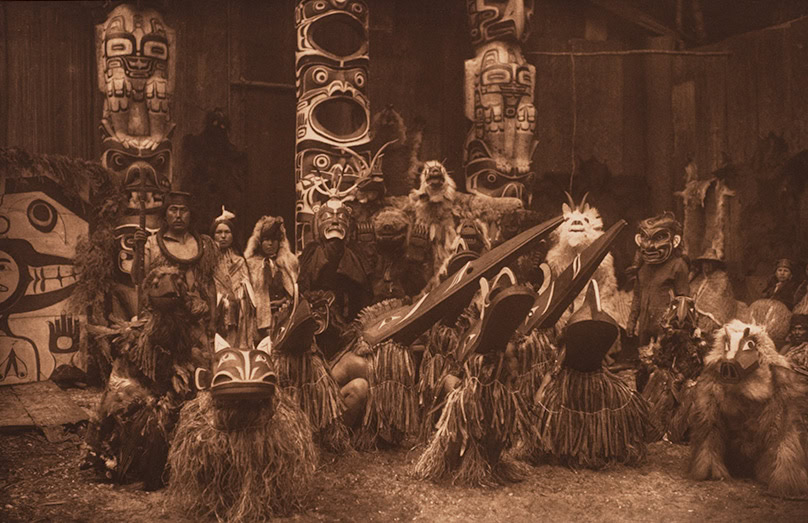
Masked Dancers – Qa'gyuhl, 1914
Few images in Curtis's forty-volume project carry the ceremonial force of this one. Masked dancers of the Kwakwaka'wakw people stand before monumental carved poles in full regalia — a formally composed image that somehow also feels alive, charged with ritual presence and controlled power.
This photogravure was exhibited in The Sacred Legacy, the landmark traveling exhibition organized by Christopher Cardozo that brought renewed scholarly and public attention to Curtis's work across museums and institutions throughout the United States. Its exhibition history is documented.
From the private collection of Christopher Cardozo, where it has been preserved since the close of the Sacred Legacy tour.
A work with this provenance — Cardozo collection, documented exhibition history, ceremonial subject matter of the first order — does not surface often.

Kotsuis & Huhhug – Nakoaktok, 1914
Kotsuis and Huhhug — supernatural beings of the Nakoaktok people — photographed in full transformation: massive bird masks, shredded cedar bark dance skirts, figures charged with ceremonial presence. Curtis set them against a plain studio backdrop. The restraint is the point.
Plate 336, Portfolio X of The North American Indian. Printed on Japanese Gampi Tissue, 18 × 22 inches. Condition: excellent.

Lone Flag – Atsina, 1908
Portfolio V - Plate 180 from The North American Indian — printed on Holland Van Gelder, Curtis's most prized European paper, and in excellent condition throughout.
Lone Flag was born in 1854 in northwest Montana. He first distinguished himself in battle against the Piegan, killing an enemy warrior and capturing a prized medicine bundle. He later saved a comrade during a Sioux attack. Curtis found in him exactly what he sought: a life fully lived, a face that held its history without apology.

Fish Shows – Apsaroke, 1908
Fish Shows was born around 1848 and fought under Chief Red Bear against the Sioux. Curtis found in the Apsaroke warriors a particular dignity — men who had lived fully inside a world already passing — and this portrait carries that quality without sentiment.
Portfolio IV - Plate 135 from The North American Indian. Printed on Japanese Gampi Tissue. Condition: excellent.

Canoeing on the Clayoquot Sound – 1915
$600. SOLD
A large dugout canoe moves through the calm waters of Clayoquot Sound off the west coast of Vancouver Island — one of Curtis's most quietly expansive images. No drama, no ceremony. Just water, vessel, and the particular stillness of the Pacific Northwest coast.
Portfolio XI -Plate 373 of The North American Indian — from Curtis's later fieldwork among the Nuu-chah-nulth people. Printed on Holland Van Gelder. 18 × 22 inches. Condition: excellent.
From the private collection of Christopher Cardozo.

Floating Aphrodite - Circa 1920 - Edward Curtis
$1,950 - SOLD
There is almost nothing like this in the Curtis canon.
Floating Aphrodite. Blue-toned silver print, with Curtis' signature, copyright,
and the notation L.A., in the negative. In vintage frame. 8.25 x 10.25" With frame 11.25 x 13.25"
Floating Aphrodite stands apart — not a portrait, not a ceremonial document, but a purely lyrical image: a figure adrift on still water, suffused in blue. Curtis rarely worked this freely. The blue-toned silver print process gives the image a quality that feels less like photography than like memory — cool, weightless, unmoored from time.
This example carries Curtis's signature, copyright notation, and the notation L.A. in the negative, and is presented in its original vintage frame. Image: 8.25 × 10.25 inches. Framed: 11.25 × 13.25 inches. Condition: excellent.
From the private collection of Christopher Cardozo — Curtis's foremost publisher and champion — where it was quietly preserved for decades before being offered here for the first time.
